How to Choose Grandstands and Stands for a Major Event: Complete Guide

Organizing a major event requires balancing perfect crowd safety with an optimal visual experience. With over 300,000 seats installed annually, from local festivals in France, the UK, USA or worldwide to large international stadiums in Morocco or Thailand, ALCOR Équipements possesses solid expertise. Consequently, we have distilled our exclusive field feedback into each section of this guide to help you choose your grandstands and stands.
Understanding the Difference Between Stands and Grandstands
When planning your spectator infrastructure, it is crucial to distinguish between stands and grandstands, as they are distinct categories of equipment suited to different operational needs in large-scale event management.
- Stands (often modular seating units) are generally versatile, used for smaller venues, secondary seating zones, or specific viewing configurations where high portability and quick adaptation are priorities.
- Grandstands are high-capacity, heavy-duty engineering structures designed specifically for major events with high spectator density. They prioritize structural safety, comfort, and visibility through complex, multi-tiered configurations, often incorporating features such as fixed individual seating with backrests, advanced access/egress solutions, and integrated roofing systems.
For a deeper understanding of these technical distinctions to help you draft your specifications, please consult our detailed guide on the difference between grandstands and stands.
| Type | Regulatory Definition | Seating | Backrest | Typical Structure | Applicable Standard |
|---|---|---|---|---|---|
| Temporary Grandstand | High-capacity structure | Individual seat | Yes | Modular metal | NF EN 13200-6 |
| Modular Stand | Flexible/mobile unit | Seat or bench | Variable | Tubular or modular | NF EN 13200-6 |

What Safety Regulations Say
Public access structures are strictly regulated. Using the correct terminology in your official permit application avoids significant administrative delays. Specifying a grandstand immediately triggers a series of in-depth inspections, particularly regarding egress and stability, emphasizing the safety-critical nature of the equipment.
Stands & Grandstands: Types and Operational Implications
Temporary modular grandstands are the industry standard for major outdoor events, offering high safety and adaptability for primary viewing areas. Modular stands are often used for secondary seating or highly specific, rapid-deployment venue requirements. This technical classification helps determine the budget allocated to transport and the load imposed on installation teams.

This Criterion Will Prevail Over the Choice of Structure
Almost all organizers first choose their seating based on desired capacity. However, engineers prioritize ground resistance. For example, a standard lawn only supports a pressure of 1 kg/cm², which renders most heavy-duty metal grandstands unusable, regardless of their impressive capacity.
Guidelines for Standards and Regulations Regarding Load Capacity
Before signing a purchase order, you must validate the load-bearing capacity of your ground with your technical department.
- Asphalt / Concrete: 20 kg/cm² (All structures)
- Pavers / Tiling: 15 kg/cm² (Tubular, lightweight modular)
- Clay: 3 kg/cm² (Lightweight modular only)
- Natural Lawn: 1 kg/cm² (Lightweight mobile stand only)
Calculating Units of Passage
Calculating spectator flow is vital to guarantee a fluid and safe evacuation. Regulations require thinking in Units of Passage (UP), each corresponding to the average width of a person in movement. The simplified formula is achieved by dividing the overall capacity by 100. A confined space may prevent the assembly of a massive grandstand if the peripheral clearances do not allow for the necessary number of units of passage.
Roofing and Wind Load
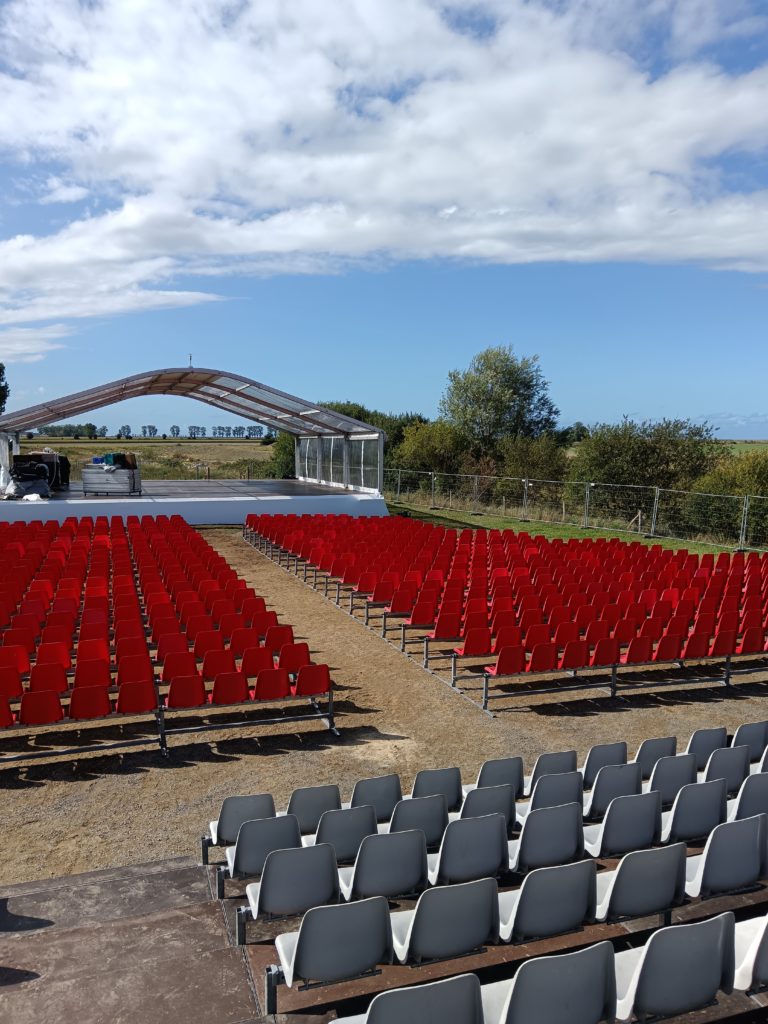
Adding a roof to your stand protects the public from rain or sun but turns your grandstand into a large sail. Consequently, structural calculations evolve drastically with the integration of wind load (expressed in kN/m²). A roof often requires weighting the base, using concrete ballast, or reinforcing structural bracing to meet stability standards.
Assembly Time: Impact on Quotes
Events schedules are often tight, and assembly delays are not an option. ALCOR Équipements stands out with an exclusive assembly system guaranteed totally without screws or bolts. This innovative device reduces assembly time compared to conventional structures and eliminates the risk of parts loosening due to vibrations (e.g., from music or crowd movement).
Regulations to Master Before Comitting
It is crucial to know that verifying structural compliance with the latest regulations is now the full responsibility of the organizer, not just the manufacturer.
NF EN 13200 Standard Requirements
NF EN 13200 Standard requirements include:
- Robust guardrails resisting crowd movements
- Specific riser heights
- Required spacing between individual seats
- Continuous integration of handrails to prevent any risk of tilting.
Safety Inspections
For larger venues, third-party inspections may be mandatory. Ensure your system is validated by an internationally recognized organization, such as Bureau Veritas, SGS, or TÜV.
Accessibility Obligations
Inclusion is essential and calculated for Persons with Mobility Requirements (PMR). Regulations require a base number of dedicated spots proportional to the total capacity, with specific required dimensions (e.g., 0.80 m wide and 1.30 m deep).
Civil Responsibility: Who Is Responsible?
The manufacturer and installer are responsible for the correct dimensioning and absolute solidity of the structure, justified by their internal registered engineering department. Conversely, the organizer assumes civil responsibility related to operation and must ensure the system was validated by an independent inspection body.
Rental vs. Purchase of Seating
Renting temporary structures always seems cheaper per unit for a first event. However, financial analysis shows that with 3 to 4 events per year over a 5-year period, you effectively pay for the structure twice without owning it.
What a Turnkey Quote Includes
A low price often hides significant gaps. A true turnkey contract by ALCOR Équipements includes conception by our certified internal engineering department, delivery, professional assembly, and dismantling. It must also include technical assistance mobilizable on the day of the event.
Recommendations for Organizers
- Event Coordinators (Single annual festival): Generally prioritize rental.
- Municipalities (Diverse manifestations): Benefit from the acquisition of modular stands or grandstands to share between services.
- Global Event Giants: Typically operate through multi-year leasing/purchase contracts.

Check-list: 15 Points to Validate Before Ordering
- Ground: Nature of terrain verified and validated.
- Capacity: Confirmed with local authorities.
- Accessibility: Exact PMR/ADA space calculation completed.
- Schedule: Assembly timeline guaranteed in writing.
- Safety: Structural calculation note included.
- Certification: Full compliance with NF EN 13200-6.
- Insurance: Provider’s Liability insurance certified/up to date.
- Legislation: Adherence to latest regulatory updates.
- Logistics: Transport included.
- Operation: Assembly/dismantling explicitly included in the contract.
- Maintenance: After-sales service included.
- Emergency: Contact available during the event.
- Configuration: Layout plan with precise dimensions.
- Assembly: Clarification on required installation team profiles.
- Compliance: Site validation by inspection body where required.